
Gay Help Line to support requests for international protection
There need for regularization, the poor knowledge of the cultural context and the risk of remaining on the sidelines They are common to all migrants in the phase immediately following their arrival in Italy. But for those who belong to the LGBTQI+ community the critical issues are raised to the nth degree and "the difficulties are 360 degrees", he underlines Alessandra Rossi, Gay Help Line coordinator, the anti-homophobia and anti-transphobia toll-free number for gay, lesbian, bisexual, and transgender people.
And that's why the Gay Center of Rome, in addition to the telephone service and chat, with the Intercultural Help Desk every other Thursday It also guarantees the possibility of obtaining a appointment with an operator, a linguistic mediator and a cultural mediator.
In 2021, calls to toll-free number 800713713 by people migrants there were about 800, 4.91 percent of the total (approximately 20,000).
Gay Help Line: 800713713 via web or Speakly chat active from Monday to Saturday, from 4pm to 8pm – Free from all over Italy, both from landlines and mobile phones
Speakly chat also in English: Monday, Wednesday and Friday
Intercultural Help Desk: every second Thursday from 4pm to 6pm, via Nicola Zabaglia, 14 (Metro B – Piramide)
People who turn to the Intercultural Help Desk they do it for a practical, strong and tangible need: the documents.
The service that the Gay Center The services we offer to those arriving from the rest of the world have changed in recent years: "before, we didn't manage a group where people could also get to know each other." The pandemic has not only changed the offering, but also the needs: "more than before, there is a need to respond to concrete needs linked to poverty or episodes of violence".
Departure and arrival have a significant weight for anyone who moves from their country of origin, but belong to the LGBTQI+ community multiplies the difficulties exponentially: "whoever leaves takes with him a traumatic experience of criminalization or persecution, which is often added to the need to move due to conditions of poverty or instability in the country in which one lives, and arrives in the Italian cultural context which is not free from discrimination on multiple fronts.".
The lack of information regarding the climate of the country of arrival, the internalized stigma which travels with people leads to closure and not to opening, to coming out, to live one's own identity freely.
There reference community, which usually represents a safe haven for migrants and plays a fundamental role in building a new everyday life in Italy, it is very often a threat because, on a scale, it can happen that you find the same one discriminatory dynamics who lives in the country of origin.
“And even the reception system isn't ready,” explains Alessandra. “But something is starting to change: there's greater attention, for example, in SAI (Reception and Integration System), which is starting to question these issues and provide training. In Italy they are still struggling to arrive, but in 2021 the Guidelines for Territorial Commissions on requests for protection based on gender-based violence“.
Get the international protection is one of the main reasons that push people to ask for support Intercultural Help DeskEvery year, thousands of lesbian, gay, bisexual, transgender, and intersex people apply for asylum in Europe.
“But we are still in a phase in which the experience and sensitivity of the judge makes the difference, the response can be variable: there are courts in which it is more plausible than others to obtain protection”, explains the educator Antonella Ugireshebuja.
The request for international protection for LGBTQI+ migrants
As can be read on the Ministry of the Interior's portal, in Italy the international protectionprovides for the refugee status or of subsidiary protection. The different protection concerns a series of objective and subjective parameters that refer to the personal history of the applicants, the reasons for the requests and the countries of origin..
In particular, the first is obtained when one is outside the country of origin due to a well-founded fear of being persecuted for reasons of race, religion, nationality, membership in a particular social group or political opinion. The second one when there are no conditions to obtain it, but there is still a actual riskto suffer serious harm.
«"Particular social group": one made up of members who share an innate characteristic or a common history that cannot be changed, or who share a characteristic or belief that is so fundamental to their identity or conscience that a person should not be forced to renounce it. Or, one that possesses a distinct identity in their country of origin because it is perceived as different from the surrounding society. Depending on the situation in the country of origin, a particular social group may be identified based on the common characteristic of sexual orientation.
LEGISLATIVE DECREE 19 November 2007, n. 251
The path to obtain international protection, precisely because it is linked to the analysis of various parameters, however, is anything but linear, especially for the LGBTQI+ people.
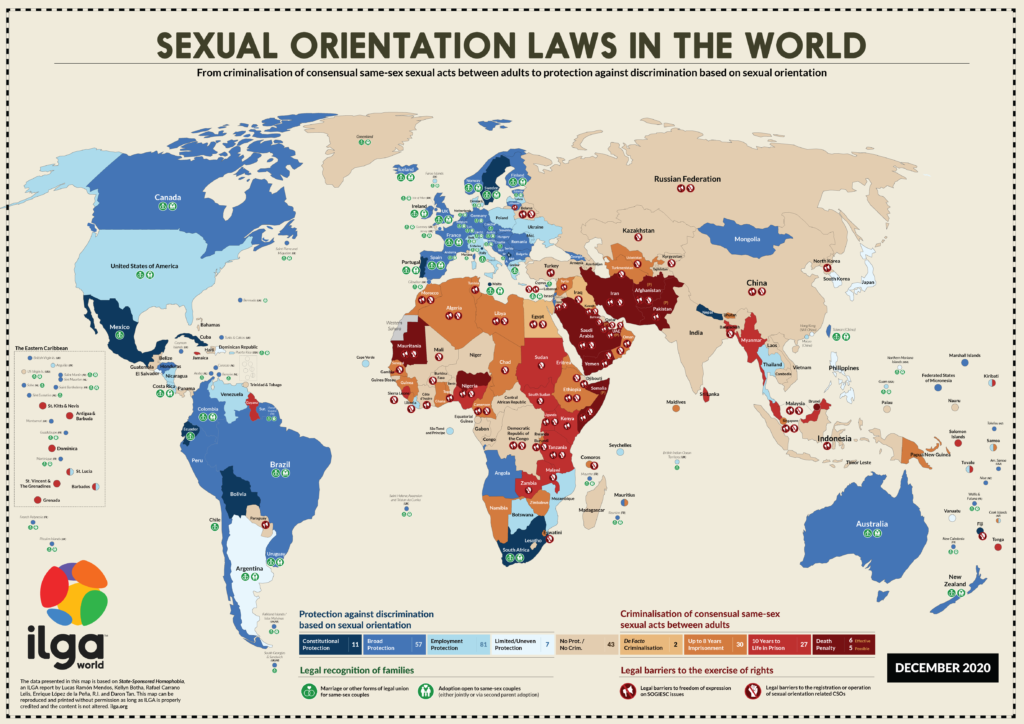
For example, coming from a country that criminalises homosexuality does not guarantee protection, even if, as stated in the report Fleeing homophobia As of 2020, in Italy criminalization itself is considered persecutory. At the same time,’lack of laws against homophobia it can't be symptom of a free context.
“"In Russia for example there is a law against Gay propaganda or even to Cuba there is a strong social stigma,” he underlines Alessandro Cataldi, Head of the Legal Help Desk. And where there is no criminalization, it is even more complicated to prove the discrimination suffered.
There is no standard rule. Even possible episodes that occurred in Italy, and not in the country of origin, can have weight: "It happened recently that a boy was attacked by other migrants from his community because he was walking with another man, the intervention of the Italian police, who included the act of discrimination in the report, was fundamental for the recognition of international protection", says Antonella.
Difficulties in accessing international protection for LGBTQI+ migrants
What matters is everyone's history and experience. Bringing it out, however, is not easy.
In addition to the need to personally overcome the internalized cultural stigma and the difficulties linked to the violence suffered, there is the difficulty expressing oneself in a judgmental context, "the rooms of the police headquarters and the presence of the Commissions do not favor the narrative", underlines Antonella Ugireshebuja. And to this must be added the great obstacle of language that the system overcomes with the presence of mediators and that for migrants of the LGBTQI+ community it's a boomerang: they represent the culture of origin, also the origin of violence, exploitation, repression.
For these reasons it is not easy for the experiences lived to emerge at the first useful meeting for the request for international protection. But the omission, an expression of the fragile condition, could make everything less truthful in the eyes of the Commission.
There Gay Help Line Coordinator, Alessandra Rossi, explains: “in the months following the first meeting there is a preparation that can lead to the desire to tell, but it can often be evaluated as a contradiction: why didn't you say it before?” A question that sounds like an accusation, but which should be an element of reflection and analysis of history.
The dialogue between migrants and the Commission is made up of obstacles rather than tools for dialogue. And there is still a another factor to consider.
“We must then take into account the fact that lawyers can exploit this vulnerable condition to get the international protection preparing, however, a story to tell that is not that of the person directly concerned", Alessandro Cataldi is keen to underline. An experience created on paper and if it is always the same it is less credible for the Commission and more exposed to contradictions for those who report it.
The recognition of the protection status passes precisely through the analysis of those objective and subjective parameters which refer to the personal history of the applicants, the reasons for the requests and the countries of origin which the Ministry of the Interior cites to explain how the access process works.
But to emerge in its complexity every story of discrimination It would require storytelling and listening, adequate time and tools, on which there is still much work to be done.
Rosy D'Elia
(June 22, 2022)